Soy Maat
A manifesto for the Transformation Age
These words claim no title and no ownership of an archetype. They declare an orientation.
Each time we say “I AM”, we give direction to the creative presence that acts through us. What we place after those words commits our attention, our decisions, and our way of being in the world.
To say “I AM Maat” is to orient that power toward truth, balance, harmony, and the correspondence between what I perceive, what I say, and what I do.
In ancient Egypt, Maat stood for the principle that could keep the order of the universe, human justice, and individual conduct in relation to one another. Today I invoke that same force as a practice for this time: to listen deeply, to discern, to find measure, and to give coherent shape to what seeks to come into form.
Maat does not belong to me. It is a principle available to anyone who chooses to put their creative capacity in the service of life.
The Transformation Age
We are living through a threshold.
Technology, knowledge, culture, work, institutions, climate, relationships, and our understanding of what it is to be human are all changing at the same time. What seemed stable for generations is now in motion.
We do not need to fix an exact date to recognize the transition. Its signs are already present in the speed of events, in the crisis of the old maps, and in the simultaneous appearance of possibilities we could not imagine until recently.
The cycles of the sky offer a symbolic mirror of this passage. They do not determine what we will do with it. They show us tensions, movements, and potentials. Free will remains at the center: no new era by itself guarantees a more aware humanity.
The conditions for a deep reorganization are in place. The direction it takes will depend on the consciousness from which we take part.
This time can enlarge our freedom or intensify our fragmentation. It can put extraordinary capacities in the service of life or turn them into new instruments of concentration and extraction.
That is why the decisive question is not only what we are capable of doing.
The question is:
What kind of life are we making possible with what we can already do?
The measure of what we create
Every creation introduces a possibility into the world.
A technology, an organization, an institution, a community, a work of art, or a narrative modifies the field in which other people will live and decide.
To create means taking responsibility for that modification.
Our technical power has grown with enormous speed. Our capacity to give it direction must grow as well. Intelligence, by itself, offers no measure. It can solve the problem we set for it without asking whether that problem should have been solved that way.
Measure is born of awareness.
It is born when we observe the relation between intention, means, and consequences. When we ask who keeps sovereignty, who takes part in the decisions, how value circulates, and what remains in the territory after our intervention.
Maat is that search for correspondence.
May vision stay true to action.
May the word stand on what is done.
May innovation not lose contact with the body, the community, and Earth.
May what we build enlarge life’s capacity to express itself.
Remembering
Outward transformation begins with an inward movement: remembering what we are.
To remember does not mean returning to an idealized identity or denying everything we have lived. It means recognizing, beneath the accumulated layers, what remains essential.
We arrive in this world with an unrepeatable combination of sensibilities, capacities, impulses, and questions. Then we meet family expectations, cultural models, needs for belonging, and roads others had imagined for us.
Some of those forms help us unfold. Others end up taking the place of our own voice.
To remember is to learn to tell them apart.
It is recognizing which choices are born of our center and which arose as adaptation. It is recovering the gifts that were set aside, understanding the trials we have passed through, and letting our experience become purpose.
We also remember at a deeper level.
We remember that our singularity does not separate us from the whole. We are an unrepeatable expression of a much larger fabric: human, natural, planetary, and cosmic. Each being is a unique perspective on a totality that no perspective can contain entirely.
We are singular and inseparable.
When this understanding finds a body, harmony stops being an imposed norm. Caring for one another, for the community, and for Earth becomes a way of caring for the great organism we are part of.
A new humanity
By a new humanity I mean a new way of being human.
It does not name a future species or a chosen few. It is a possibility that already exists in us and begins to take form when we remember our interdependence without giving up our singularity.
A humanity able to recognize itself as woven together.
A humanity where truth can be sought without becoming a weapon; where balance allows movement; where harmony protects differences; where what is enough can circulate and nourish what it touches; where power means the capacity to contribute.
This humanity emerges when each person recognizes and takes their place in the whole.
To take our place does not mean installing ourselves at the center or becoming a subordinate piece of the whole. It means embodying what only we can bring, and putting it in relation to the gifts of others.
Each being has a singular position from which to perceive, understand, and act. When that position finds purpose, diversity stops producing only dispersion and begins to produce collective intelligence.
The order is being, doing, and having.
Being offers direction.
Doing gives it body.
Having arrives as fruit, resource, and support for what we have set in motion.
When the order is inverted, we look to accumulation for an identity we do not yet remember. When the order is restored, resources can return to their function: to nourish purpose and let the work continue.
From singularity to convergence
Authentic collaboration begins between sovereign parties.
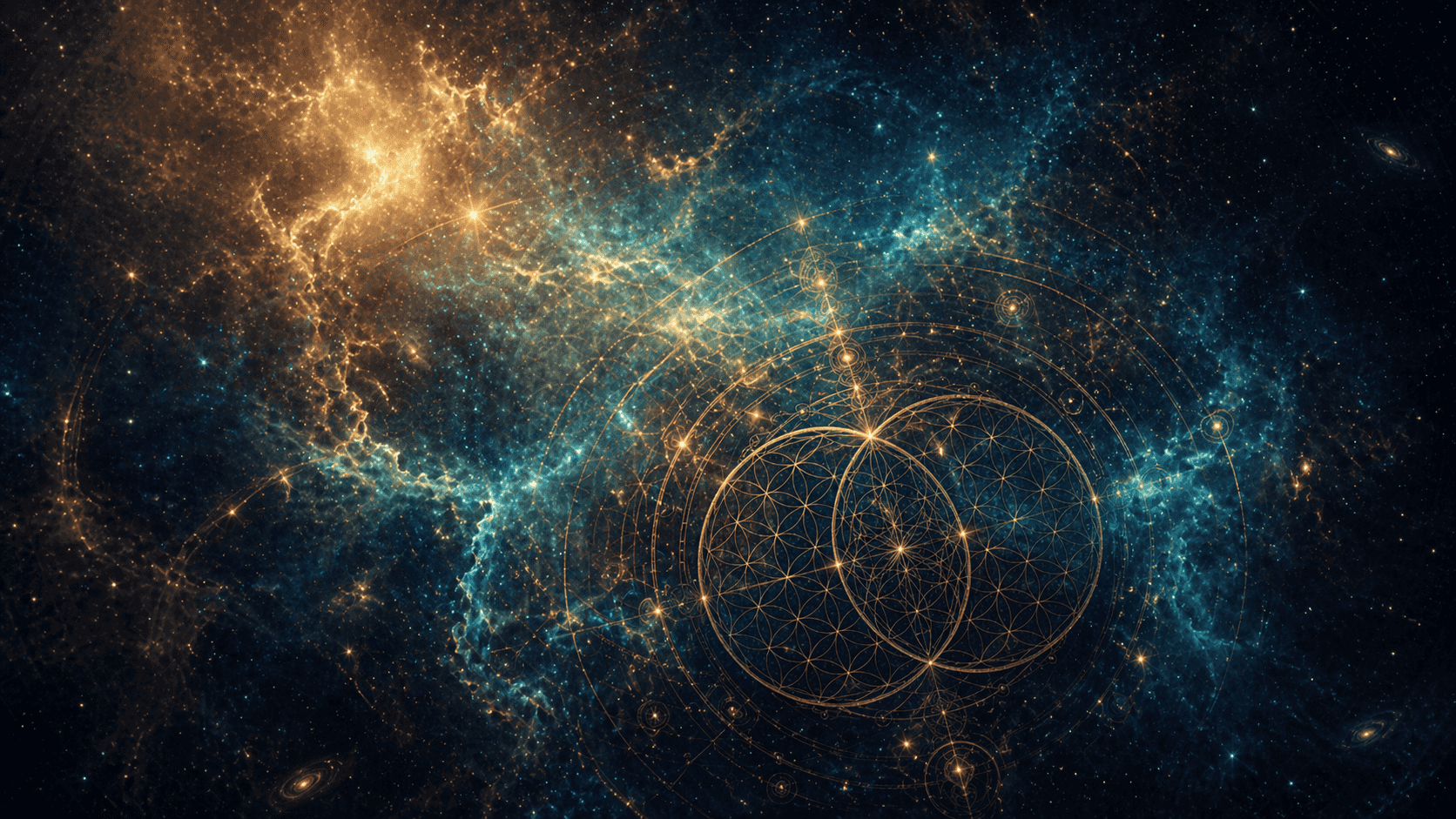
The vesica piscis offers a precise image of this principle: two circles meet without disappearing into one another. In their intersection a third space is born, one that belongs entirely to neither.
There creation begins.
That third thing can be an understanding, a relationship, a community, a work, or a possibility that neither party could have produced alone.
Convergence does not demand that we become the same. It needs us to arrive whole.
We live surrounded by people, projects, and initiatives working toward compatible futures, but often they remain scattered. Each one develops knowledge, relationships, methods, and resources that rarely manage to recognize themselves as part of a shared fabric.
A new humanity needs connective tissue.
It needs trust, shared memory, languages able to translate between worlds, clear agreements, and infrastructures that let us find each other without surrendering our sovereignty.
When what is scattered begins to recognize itself, efforts can synchronize. Knowledge circulates. Resources find direction. Initiatives stop competing to exist and discover what they can sustain together.
To cooperate is not only to add up capacities. It is to let something emerge that did not exist before.
Technology with purpose
Technology amplifies the intention of those who develop it and of the systems within which it operates.
That is why its orientation matters as much as its power.
I choose a technology that strengthens human agency, preserves the sovereignty of knowledge, and eases cooperation among people, collectives, and territories. A technology able to help us perceive relationships, recognize opportunities, and coordinate efforts without replacing human responsibility.
Artificial intelligence can enlarge our capacity to understand and act together. To do so, it must remain in the service of the people and the communities that generate the knowledge it works on.
Technology can also be a form of care: to protect sovereignty, to sustain relationships, to reduce unnecessary friction, and to give back time and the capacity to decide.
Interoperability, transparency, and the possibility of leaving are not only technical decisions. They are expressions of an ethic.
Infrastructure also embodies values.
It can raise walls or build bridges. It can capture attention or give back capacity. It can extract value from territories or let that value stay, circulate, and strengthen them.
We choose the bridges.
One work, on my road, today takes on two complementary dimensions.
SynchroLabs works toward the whole: it builds conditions for people, collectives, and territories to recognize themselves within a fabric, synchronize initiatives, and enlarge their capacity for action.
El Juego de la Vida works toward the interior: it offers a symbolic cartography for remembering, integrating polarities, and walking the movements of human experience with awareness.
One dimension organizes the encounter.
The other prepares the being who arrives at it.
Both are born of the same question: how to turn a vision into a form able to serve life.
From sky to Earth
Every vision needs to travel a distance.
First it appears as intuition, image, intimation, or possibility. Then it must pass through discernment, find words, bind itself to other people, take on limits, and receive structure.
Finally, it must touch Earth.
My practice is to accompany that whole course: to listen for what seeks to emerge, to understand its architecture, and to join vision to action.
The spiritual and the material are dimensions of one and the same process. An idea that never finds a body remains incomplete. A structure that has lost contact with its purpose ends up emptying itself of meaning.
The hermetic principle reminds us that what is above and what is below correspond; that the inner and the outer reflect and transform one another.
To embody means to sustain that correspondence.
To bring the vision all the way into relationships, budgets, code, agreements, rhythms, decisions, and consequences.
To make matter an expression of purpose.
The commitment
My commitment is to orient what I create toward truth, balance, and life. What we propose outward must begin in the way we relate, decide, and build inward.
To listen before defining.
To discern before affirming.
To give form without capturing.
To connect without homogenizing.
To take my own place without claiming the whole process.
I commit myself to building bridges between worlds that have often stayed apart: spirituality and technology, intuition and method, singularity and community, purpose and prosperity.
To receive counsel without surrendering my authority.
To recognize that every work needs contrast, measure, and relationships able to tell the truth.
To let value also circulate toward those who sustain the creation. Giving that empties itself cannot regenerate. Abundance held with awareness makes it possible to care for, continue, and multiply what the work sets in motion.
And I commit myself to keeping open the question that orients this whole course:
Are we creating for life?
The call
This manifesto doesn’t ask you to join my movement.
It invites you to recognize the movement that already exists in you, and to discover where it can meet the movement in others.
Perhaps you’re building a technology, a community, an organization, a territory, a school, a work of art, a spiritual practice, or a new form of economy.
Perhaps you still sense only a sign.
The first step is to remember.
Then, to take your place.
And from there, we find each other.
The transition will not be carried by a single center, a single theory, or one large organization able to contain it all. It will be carried by many centers aware of their interdependence: people and initiatives able to recognize one another, learn from one another, and cooperate without losing their essence.
We have the possibility of bringing our visions into relation with one another, synchronizing efforts, and orienting our capacities toward the world we want to inhabit.
That world will not arrive finished.
It will take shape in the quality of our relationships, in the direction of our attention, and in each decision by which a possibility becomes real.
This is the call:
To remember what we are.
To take our place.
To create from our own being.
To collaborate from our own sovereignty.
To give body to a shared vision.
I AM Maat.
I say it as an orientation, a practice, and a commitment.
And in saying it, I choose to create for life.
We create the connective tissue
of a new humanity.